Romilly Script Handwritten Font for Creative Makers
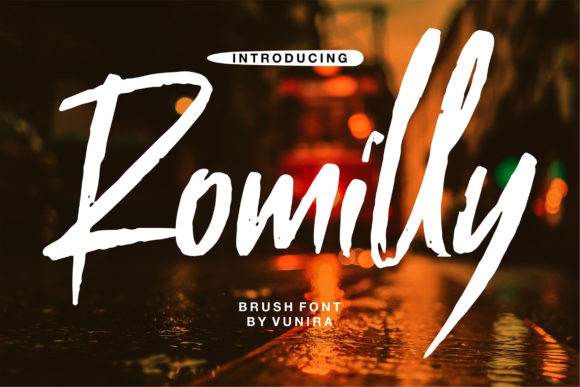
There’s that quiet moment—just before printing—when you zoom in on your candle label mockup and pause. The scent name “Lavender & Rain” sits there, crisp but lifeless in a generic script. You try another font. Then another. Nothing feels *right*—until you type it in Romilly. Suddenly, the letters breathe: soft curves, gentle tapering strokes, a subtle brush texture that catches the light just so. That’s when you know—this is the Script Handwritten font your handmade goods have been waiting for.
Romilly for Wedding Invitations and Elegant Branding
When designing wedding stationery—whether digital printables or letterpress-ready files—you need a font that whispers intention without shouting. Romilly delivers exactly that: relaxed enough to feel personal, flowing enough to suggest movement and grace, and uniquely shaped to stand apart from overused calligraphy fonts. Its lowercase ‘g’ and ‘y’ have delicate, open counters; its capitals carry quiet confidence—not ornate, not stiff, but unmistakably hand-drawn. I used Romilly for a set of welcome board templates and found it paired beautifully with a clean, airy sans serif (like Montserrat Light) for body text—letting the Script Handwritten font shine where it matters most: names, dates, and heartfelt phrases like “Together with joy.”
Romilly for Candle Labels and Small-Batch Packaging
Candle labels live in tight spaces—3″ x 2″ sticker real estate, curved jar surfaces, minimalist kraft tags. Not every Script Handwritten font holds up at 14pt. But Romilly does. Its generous x-height and open letterforms stay legible even when scaled down, and its brushed texture adds tactile warmth that mirrors soy wax and linen wraps. I tested it on matte vinyl stickers: no jagged edges, no lost detail—even the subtle swash on the capital ‘R’ stayed crisp through my Cricut Maker’s fine-cut setting. For best results, avoid using Romilly for full ingredient lists—but absolutely lean into it for scent names (“Honeyed Fig,” “Coastal Mist”), brand lines (“Hand-poured in Portland”), and seasonal tags (“Holiday Collection • 2024”).
Romilly for Printable Wall Art and Planner Pages
Digital downloads thrive on personality—and Romilly brings instant character to printable wall art and functional planner pages. As a Script Handwritten font, it balances decorative appeal with quiet sophistication. Try it for affirmations (“You are enough”), minimalist quotes (“Breathe. Begin.”), or weekly headers (“Slow Sundays”). Because Romilly includes stylistic alternates and ligatures, you can easily swap in a flourished ‘&’ or a connected ‘th’ pair—adding polish without extra design time. For planner inserts, I layer Romilly headlines over a neutral sans serif body (think Inter or Open Sans)—keeping readability high while letting the Fonts do emotional heavy lifting.
Romilly for Boutique Tags and Handmade Product Labels
Boutique tags—those little kraft paper hangtags on ceramic mugs, woven totes, or dried floral bundles—need to feel intentional, not incidental. Romilly gives them soul. Its relaxed rhythm mimics the natural variation of ink-on-paper, so even digitally printed tags look hand-finished. When cutting with Silhouette Studio or Cricut Design Space, I always convert Romilly to outlines first—especially for small sizes—to preserve those uniquely shaped letters. And because Romilly is a commercial-use font, I confidently include it in SVG cut files sold as digital craft assets (with proper licensing review, of course).
Romilly for Greeting Cards and Seasonal Printables
Seasonal greetings—think “Merry & Bright,” “You’re My Person,” or “Happy First Birthday”—deserve more than cookie-cutter scripts. Romilly offers expressive nuance: a slightly bouncy baseline, soft entry/exit strokes, and letterforms that feel both familiar and fresh. It’s especially effective on textured cardstock or foil-stamped prints—the brush texture translates beautifully to physical media. For holiday sticker sheets, I use Romilly for main phrases and pair it with a simple serif (like Playfair Display) for smaller details (“Est. 2022,” “Handmade with Love”)—creating visual hierarchy without visual noise.
Romilly for Tote Bags, Mugs, and Apparel Designs
When screen-printing or heat-pressing onto fabric or ceramic, clarity and contour matter. Romilly’s flowing nature reads well at medium sizes (1.5–3″ wide), especially on light backgrounds. Its unique shaping—like the tapered tail on ‘j’ or the rounded bowl of ‘a’—adds charm without sacrificing recognizability. I’ve used it for tote bag slogans (“Carry Kindness”), mug quotes (“Coffee First, Questions Later”), and even small-batch t-shirt designs—all with strong customer feedback on perceived quality. Just remember: test your file in vector format first, and always check that included weights (regular, bold, italic) support your intended layout.
Romilly for Digital Download Previews and Shop Branding
Your Etsy or Shopify listing images are often the first impression—and Romilly helps your digital download previews feel premium, cohesive, and on-brand. Whether you’re showing a mockup of a printable menu, a wedding suite, or a planner bundle, Romilly elevates the aesthetic instantly. As a Script Handwritten font, it signals care and craft—telling buyers this isn’t mass-produced, but thoughtfully made. Use it consistently across cover graphics, feature banners, and social media teasers to reinforce recognition. And yes—it’s fully compatible with Canva, Adobe Illustrator, and Affinity Designer, so your workflow stays smooth.
Before You Download Romilly Fonts
Always verify what’s included: look for OTF/TTF files, stylistic sets, multilingual glyphs (if needed for your audience), and clear commercial licensing terms—especially if you’re selling physical products, SVG bundles, or editable Canva templates. Romilly works best as a display font—not for long paragraphs—but shines in titles, names, short phrases, and decorative accents. Let it lead with feeling, then support it with a grounded companion font. Your handmade work deserves typography that feels like part of the making—not an afterthought.