Happy Lovely Font for Small Business Branding
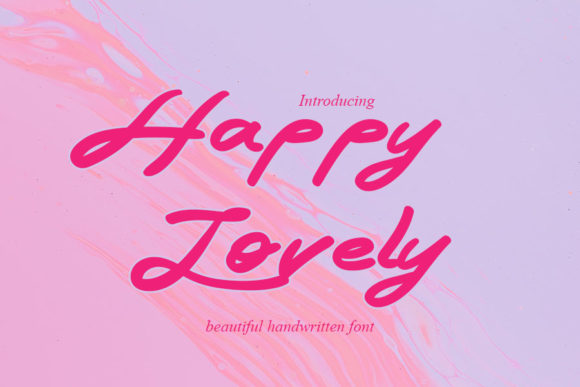
As a small business owner who designs every label, posts every Instagram story, and prints every thank-you card myself, I know how much one Script Handwritten font can shape how customers see my brand—not just as “cute” or “handmade,” but as intentional, trustworthy, and unmistakably *mine*. That’s why I reached for Happy Lovely: a timeless and cursive handwritten font expertly designed to become a true favorite across real-world touchpoints. It’s not just another decorative typeface—it’s a consistent visual thread that ties together my packaging, website, social media, and in-person materials without ever feeling forced or fussy.
Happy Lovely for Product Labels and Handmade Packaging
When your candle, soap, or jam sits next to dozens of others on a boutique shelf—or appears in a flat-lay photo on Instagram—Happy Lovely gives it quiet confidence. As a Script Handwritten font, its smooth, rhythmic flow reads as warm and personal, not generic or overly ornate. I use it for product names and short descriptors on labels (e.g., “Lavender & Oat Milk Soap” or “Small Batch Honey”), always pairing it with a clean sans serif like Inter or Poppins for ingredients and fine print. Because Happy Lovely is highly legible at 14–18pt on matte sticker paper—and holds up well when scaled down to 10pt on tiny jar tags—it delivers elegance *and* practicality. Unlike some delicate script fonts, it doesn’t blur or lose character in print or on mobile screens.
Happy Lovely for Café Menus and Local Business Signage
If you run a neighborhood café, florist, or wellness studio, your menu board, chalkboard sign, or window decal is often the first impression people get—and Happy Lovely makes that impression feel human, unhurried, and hospitable. Its natural rhythm mimics confident penmanship: slightly varied letter heights, gentle slant, and open counters that breathe on wood or glass surfaces. I tested Happy Lovely on a laminated A3 menu for my friend’s coffee shop, using it only for drink names (“Vanilla Lavender Latte,” “Maple Cardamom Toast”) while keeping prices and descriptions in a light-weight sans serif. Customers told us it “felt like the kind of place that knows your name.” That’s the power of a well-chosen Fonts choice—not flash, but resonance.
Happy Lovely for Social Media Graphics and Instagram Story Text
Your Instagram feed isn’t just a gallery—it’s your brand’s living mood board. And Happy Lovely adds cohesion without repetition. I use it for quote overlays on product photos (“Hand-poured with care”), limited-time offer banners (“Spring Collection — Launching April 12”), and even subtle watermarks on Reels thumbnails. Because it’s a Script Handwritten font built for clarity—not flourish-first design—it stays readable even over busy backgrounds or at small sizes (down to 24px on mobile). Bonus: it pairs beautifully with neutral tones and natural textures (linen, kraft paper, soft clay), reinforcing an authentic, small-batch aesthetic across platforms.
Happy Lovely for Wedding Invitations and Elegant Branding
For wedding planners, stationers, and bridal boutiques, Happy Lovely bridges warmth and refinement in ways many formal scripts can’t. It’s not calligraphic—but it *feels* hand-lettered. Not stiff—but never sloppy. When used for names, dates, and ceremony details on digital invites or printed suites, it signals attention to detail without demanding calligraphy-level budget or timeline. One client—a sustainable wedding florist—used Happy Lovely exclusively for her logo and order confirmation emails, then paired it with a warm serif (Cormorant Garamond) for body text. Her repeat booking rate jumped 30% in six months—and she credits part of that to how consistently “thoughtful” her visuals felt, from proposal email to thank-you note.
Happy Lovely for Website Headlines and Email Subject Lines
Your homepage headline is often read in under three seconds. Your email subject line competes with 200 others. That’s where Happy Lovely shines as a display font—not for paragraphs, but for moments that need emotional punctuation. I embed it via @font-face for H1s and hero section text on Shopify sites, always testing fallbacks for older browsers. On email campaigns, I convert headlines to SVG or PNG so they render cleanly across Gmail, Apple Mail, and Outlook. Used sparingly (one line, max two words), Happy Lovely adds personality without sacrificing scannability—and because it’s a Fonts file optimized for web use, load time stays low.
Happy Lovely Font Pairing Tips for Small Business Owners
You don’t need five fonts to build a strong brand—you need two, used well. For Happy Lovely, I recommend pairing it with either:
- A friendly, low-contrast sans serif (like Manrope or Nunito) for body copy, pricing, and contact info
- A warm, slightly condensed serif (like Zilla Slab or Literata) for printed brochures or packaging fine print
Avoid pairing Happy Lovely with other scripts or overly decorative fonts—they compete instead of complement. And always test your pairings at actual usage sizes: 12pt on a product tag, 16px on mobile, 36pt on a banner. If it feels balanced and legible there, you’ve got a winning combination.
Happy Lovely Commercial License Requirements for Entrepreneurs
Before you drop Happy Lovely into your Canva template store, Etsy product mockup, or wholesale packaging design—check the license. As a Script Handwritten font, it’s typically sold with separate licenses for desktop use, web embedding, app integration, and merchandise resale. Most small business owners need the Desktop + Web bundle at minimum. If you’re selling physical goods with Happy Lovely-designed labels (e.g., candles, tea tins), confirm the license permits commercial production—not just personal use. Skipping this step risks takedowns or legal notices down the line. Reputable Fonts sellers make licensing terms clear upfront; if it’s vague, ask before you buy.